For generations, Indian children learned to count with tamarind seeds, built hand strength spinning a wooden top, and picked up their first stories from a cloth puppet. What once looked like simple play is now recognised as something far more powerful: a complete, hands-on way to learn. This approach has a name — toy-based pedagogy — and India’s own indigenous toys are among the best teaching tools ever made for it. This guide explains what toy-based pedagogy is, why it matters more than ever under India’s new education policy, and exactly how specific traditional Indian toys build real skills in young children. Whether you are a parent, an early-years educator, or someone running a children’s learning programme, you’ll find a practical, toy-by-toy breakdown you can use straight away.
What Is Toy-Based Pedagogy?
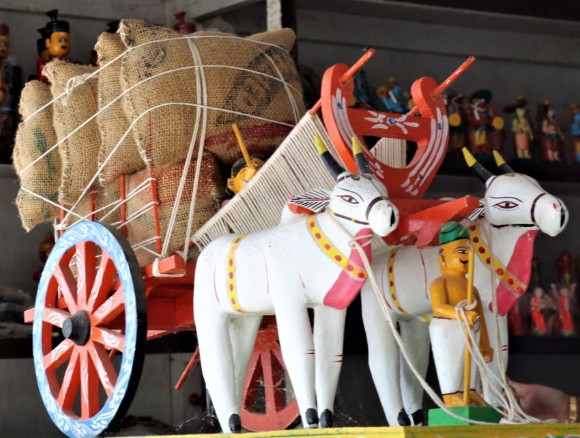
Toy-based pedagogy is a teaching method that uses toys and games as the main tools for learning, rather than treating them as a break from “real” study. Children buildcognitive, social, emotional, and physical skills through guided, hands-on play. The idea is simple but profound: young children learn best by doing. When a child sorts wooden rings by size, they aren’t just playing — they are absorbing concepts of size, sequence, and order through their hands and eyes before they can put those ideas into words. Play turns abstract concepts into concrete, memorable experiences. This stands in direct contrast to rote memorisation. Lectures and repetition often limit a young child’s engagement and curiosity. Play-based learning does the opposite: it invites exploration, problem-solving, and discovery, which is how deep understanding actually forms in the early years.
Why Toy-Based Pedagogy Matters Now?
The NEP 2020 Connection
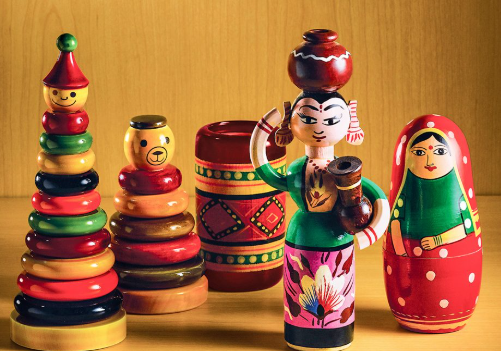
Toy-based learning is no longer just a nice tradition — it is national education policy in India. The National Education Policy (NEP) 2020 marks a definitive shift toward experiential, play-centred learning in the foundational and preparatory years. It specifically calls for using puzzles, games, and toys as teaching tools, and for rooting curriculum and pedagogy in the ethos of Indian culture. This vision is spelled out in detail in the National Curriculum Framework for the Foundational Stage 2022, which places play at the very centre of how young children learn and explicitly values India’s folk toys and traditional games. Crucially, the policy puts indigenous toys at the centre. The Government of India has released a dedicated Toy-Based Pedagogy framework aimed at children aged 3 to 18, designed to help them grasp basic concepts of science and mathematics while developing sensory and motor skills. The focus is deliberately on Indian toys and games — the spinning top (lattoo), the spin-wheel (firki), kites, the rattle (dug-dugi), and many more. For parents and educators, this matters for two reasons. First, it means using traditional toys is backed by serious pedagogical thinking, not nostalgia. Second, it is genuinely accessible — toy-based pedagogy is something parents can use at home just as easily as teachers use it in a classroom.
What Makes Indigenous Indian Toys Special?
India has an extraordinarily rich toy-making heritage, with distinct craft traditions across regions. A few of the most celebrated:
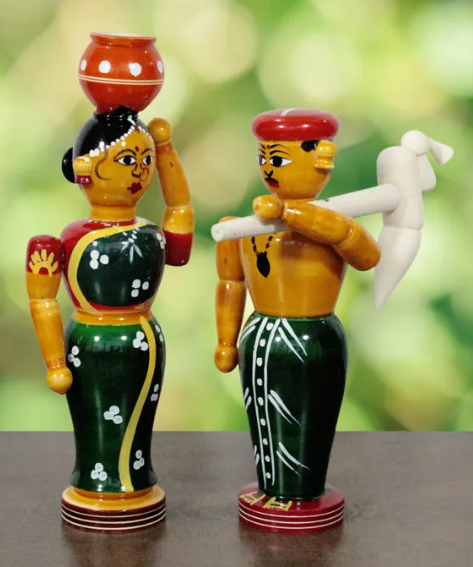
Channapatna toys (Karnataka). From the town affectionately called Gombegala Ooru, or “Toy Town,” near Bengaluru, these lacquered wooden toys are UNESCO-recognised. They are carved from soft ivory wood (Wrightia tinctoria, locally “Aale Mara”) andcoloured with natural turmeric, indigo, and kumkum dyes — making them kid-safe and non-toxic. The range includes stacking rings, spinning tops, dancing dolls, pull-along carts, and skill puzzles.
Etikoppaka toys (Andhra Pradesh). Similar lacquered wooden toys, made from the same Ankudu (Wrightia tinctoria) wood and finished with natural lac resin. They are prized for their eco-friendly production and glossy, smooth finish.
Kondapalli toys (Andhra Pradesh). Painted wooden figures — dancing dolls, bullock carts, animal and mythological figures — carved from soft tella poniki wood, a tradition centuries old. Beyond their beauty, these toys share a quiet advantage: sustainability and safety. Made from natural wood and dyes, they are safer and more durable than many mass-produced plastic alternatives — an important consideration for very young children who explore with their mouths as well as their hands.
How Specific Traditional Toys Build Real Skills?
The real strength of indigenous toys is that each one naturally targets particular developmental skills. Here is a practical mapping educators and parents can use.
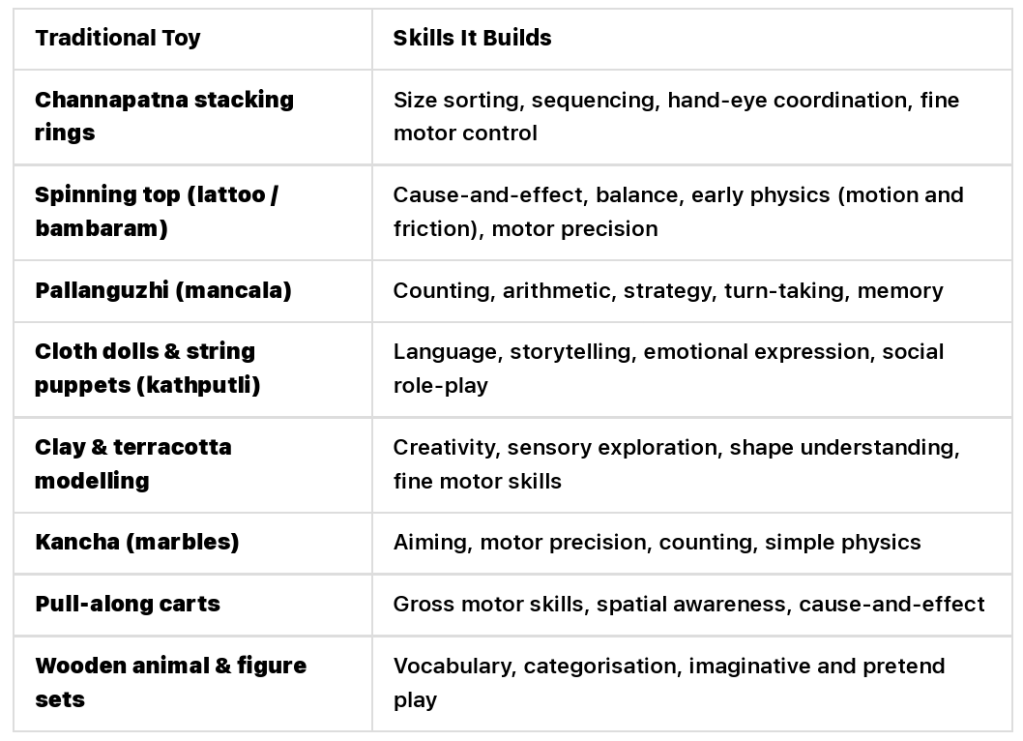
Notice how a single toy often teaches several things at once. This is the “multidisciplinary” quality NEP 2020 highlights — one wooden top quietly delivers a physics lesson, a motor-skills workout, and a lesson in patience, all inside a few minutes of joyful play.
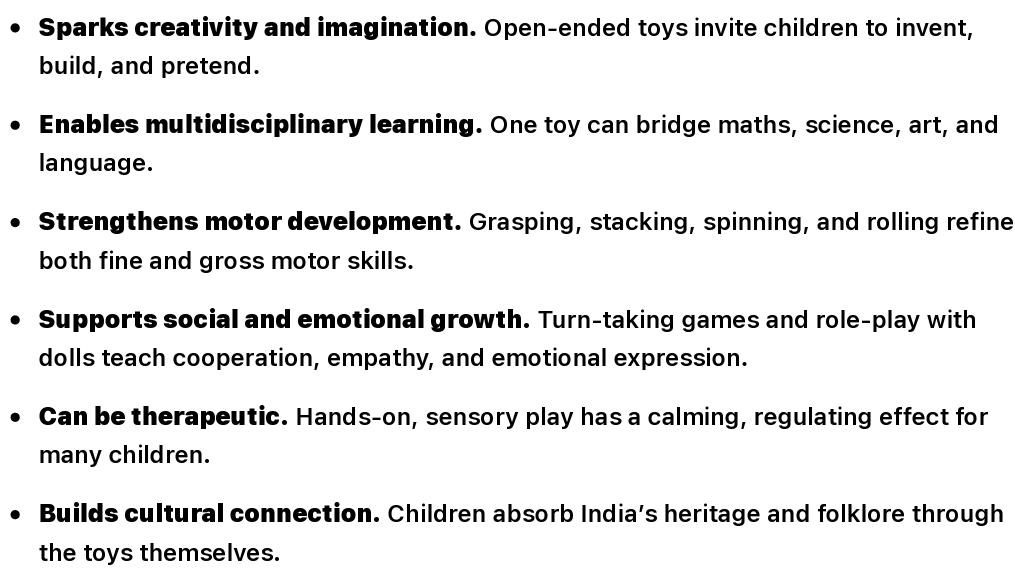
The Core Benefits of Learning Through Toys :
Bringing indigenous toys into early learning delivers benefits that reach well beyond any single subject:
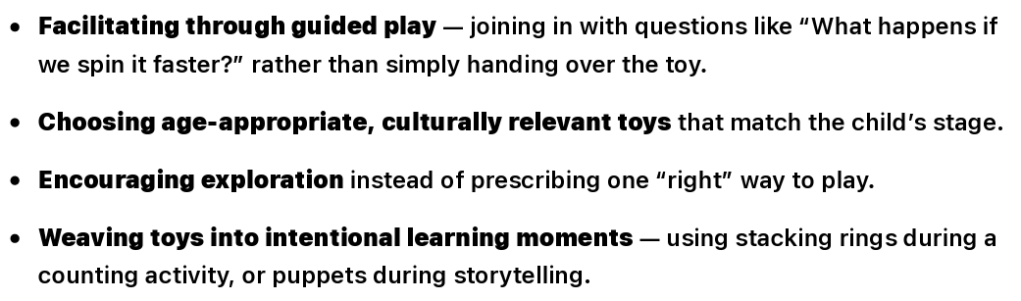
The Adult’s Role:
Toys Alone Don’t Teach An important truth: toys do not teach on their own. The adult — parent or educator — is what turns play into learning. Effective toy-based pedagogy means:
The reassuring part is how natural this is. You don’t need special training to ask a curious question or to count marbles together. Guided play is something any caringadult can do.
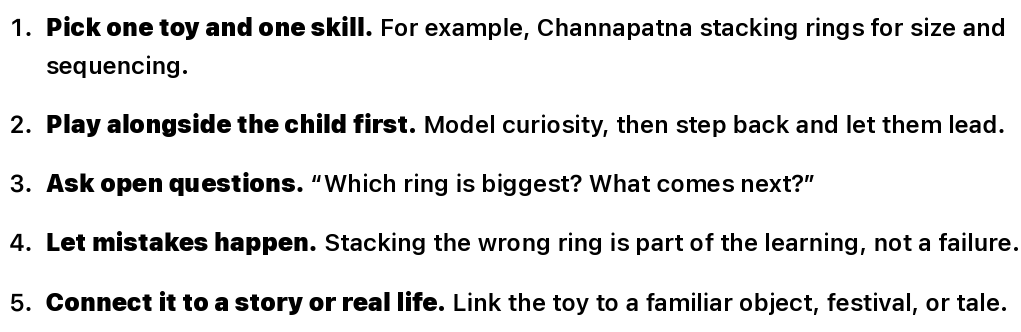
A Simple Way to Start at Home or in the Classroom You don’t need a cupboard full of toys to begin. Start with one or two well-chosen indigenous toys and a clear intention:
Over time, you build a small, meaningful collection where every toy has a learning purpose — far more valuable than a pile of plastic that lights up but teaches little.
Preserving a Heritage While Teaching the Future :
There is a bittersweet urgency here. Many of India’s traditional toys and games have been quietly pushed out of childhoods by digital entertainment and mass-produced imports, and artisan communities in places like Channapatna face real competition from cheap replicas. Choosing indigenous toys does something rare: it teaches your child and helps keep a living craft — and the families who sustain it — alive. That dual value, learning and legacy, is exactly why toy-based pedagogy with indigenous toys resonates so deeply. It is education that carries culture forward in a child’s own hands.
Conclusion :
Toy-based pedagogy reframes play as one of the most effective forms of early learning — and India’s indigenous toys are perfectly suited to it. Backed by NEP 2020, rich in cultural meaning, and remarkably good at building real skills, toys like Channapatna stackers, Pallanguzhi boards, and cloth puppets give young children a way to learn that is joyful, hands-on, and rooted in their own heritage. The best next step is a small one: pick a single traditional toy, sit down beside a child, and turn play into discovery. That is toy-based pedagogy in its truest form.
Frequently Asked Questions
What is toy-based pedagogy in simple terms?
It is a teaching approach that uses toys and games as the main tools for learning, helping children build thinking, social, emotional, and physical skills through hands-on, guided play rather than rote memorisation.
Does NEP 2020 support toy-based learning?
Yes. NEP 2020 promotes experiential, play-based learning in the foundational and preparatory years and specifically encourages the use of puzzles, games, and indigenous toys, with a dedicated government framework for children aged 3 to 18.
Which Indian traditional toys are best for young children?
Channapatna stacking rings and spinning tops, Pallanguzhi (mancala), cloth dolls and puppets, clay modelling, and wooden figure sets are all excellent — each builds a specific set of skills while being safe and durable.
Can parents use toy-based pedagogy at home?
Absolutely. It requires no special training — just one or two well-chosen toys, playing alongside the child, and asking open, curious questions to turn play into learning.
Why choose indigenous toys over plastic ones?
Traditional Indian toys such as Channapatna and Etikoppaka are typically made from natural wood and non-toxic dyes, making them safer and more sustainable, and they carry cultural heritage that mass produced toys cannot.


Leave a Reply