Introduction
Screens have become a near-constant presence in the lives of young children — from television playing in the background to tablets used to soothe a restless toddler. Yet a substantial and growing body of research indicates that the early years, particularly from birth to age five, constitute a uniquely sensitive window for cognitive, linguistic, and socio-emotional development. During this period, the activities that a child is not doing — because a screen has displaced them — may matter as much as the content onthe screen itself.
This article makes the case that intentional screen-free activities for young learners are essential to healthy development, and offers a research-grounded framework for prioritising them at home and in early-years settings.
What the Guidelines Say About Screen Time ?
Leading health authorities have converged on notably cautious recommendations for early childhood.
The World Health Organization (WHO), in its guidelines on physical activity, sedentary behaviour, and sleep for children under five, advises no sedentary screen time for infants under one year, no screen time for one-year-olds, and no more than one hour per day for children aged two to four — with less time considered preferable. The WHO frames screen use within the child’s full twenty-four-hour day, emphasising that adequate sleep and physical activity should take precedence.
The American Academy of Pediatrics (AAP) similarly recommends avoiding screen media, other than live video chatting, for children under eighteen months, and limiting use to high-quality, co-viewed content thereafter.
These are not arbitrary limits. They reflect an evidence-based concern that excessive early screen exposure displaces the experiences on which young brains depend.
Why Screen-Free Time Matters: The Evidence
1. Young children learn poorly from screens — the “video deficit effect” Research has consistently documented what is termed the video deficit effect: children under the age of two learn markedly less from screen-based presentation than from equivalent real-life interaction. Studies have found that toddlers may take considerably longer to imitate an action demonstrated on video than one demonstrated by a person present in the room. In short, at this age, a living, responsive human teacher is not merely preferable to a screen — it is developmentally superior.
2. Screen time displaces language-rich interaction
Early language acquisition depends on responsive, back-and-forth exchanges with caregivers — the “serve and return” of everyday conversation. Passive screen viewing offers no such reciprocity. Excessive screen exposure has been associated in the research literature with reduced vocabulary, weaker communication skills, and diminished eye contact, precisely because it substitutes one-way stimulation for genuine interaction.
3. Unstructured, screen-free play builds the whole child
Decades of developmental psychology affirm the value of free, unstructured play. The American Psychological Association describes such play — activity not directed by adults and without a predetermined outcome — as fundamental to children’s physical, emotional, cognitive, and social flourishing. Documented benefits include:
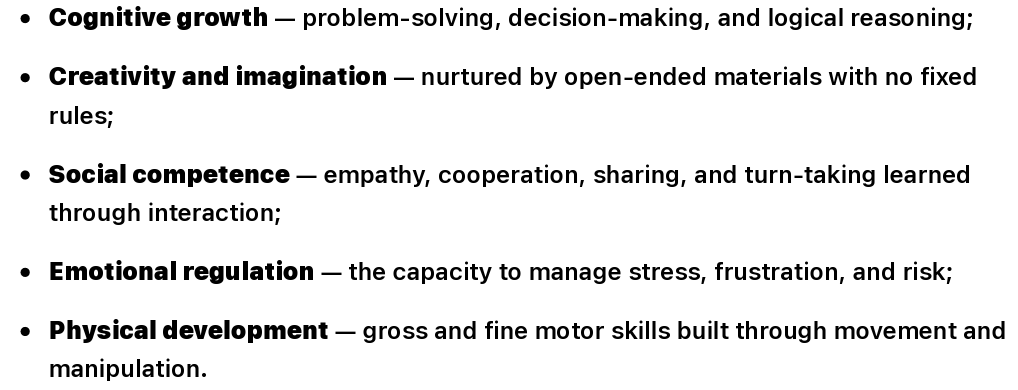
Systematic reviews of unstructured and nature-based play report consistent associations with improved health and developmental outcomes, reinforcing that play is not a break from learning but a primary vehicle for it.
4. Physical, visual, and sleep health
Because screen use is inherently sedentary, it competes with the physical activity essential to healthy growth and has been linked to rising early-childhood obesity risk. Screen exposure — particularly close to bedtime — can also disrupt sleep onset and quality, while prolonged near-viewing raises concerns for developing vision.
Screen-Free Activities for Young Learners: Practical Ideas
Reducing screen time is most successful when the screen is replaced with something engaging rather than simply removed. Effective, low-cost options include:
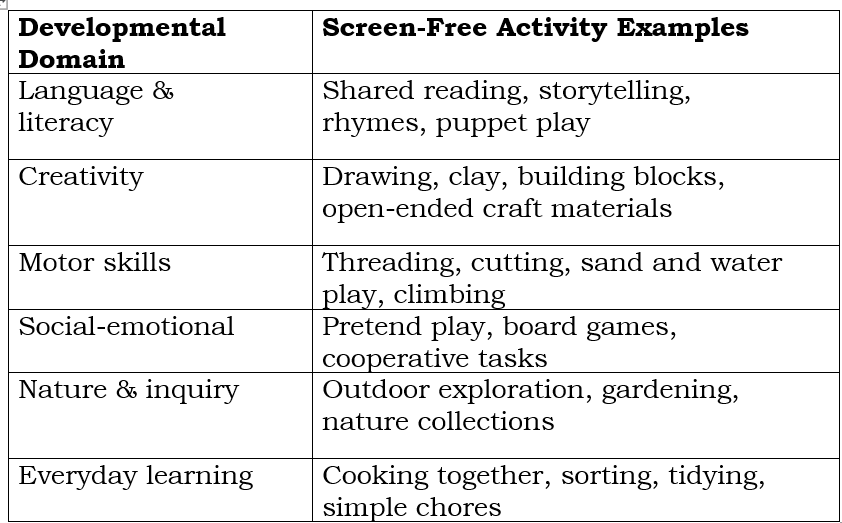
The guiding principle is that ordinary materials — blocks, containers, fabric, natural objects — often invite richer, more imaginative play than pre-programmed digital toys.
Guidance for Educators and Parents
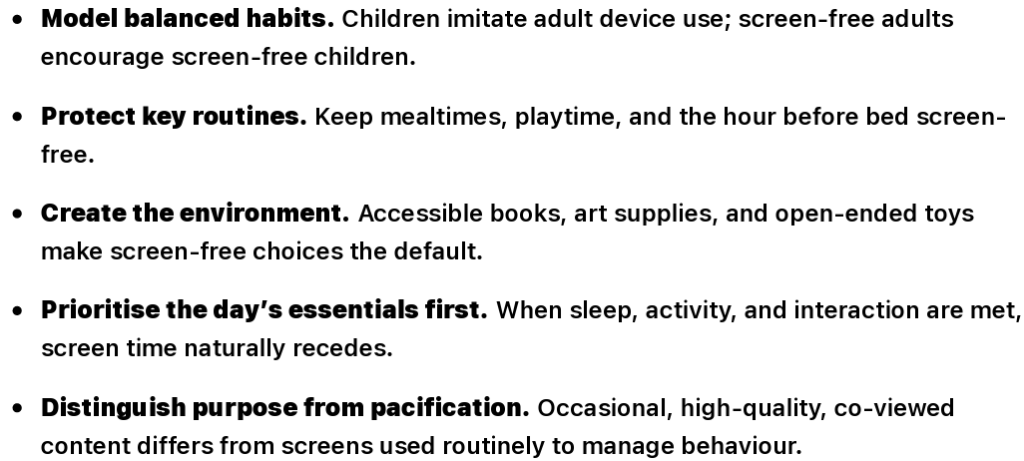
The aim is not the elimination of technology, but the protection of the irreplaceable experiences of early childhood.
Conclusion
The research is coherent and consistent: for young learners, screen-free time is a developmental necessity rather than a matter of preference. The early years offer a narrow and precious window in which language, thinking, relationships, and selfregulation take shape — and these capacities are built through interaction, movement, and play, not through passive viewing. By intentionally prioritising screen-free activities for young learners, educators and families give children what the evidence shows they most need: a rich, human, hands-on start to learning.
Frequently Asked Questions (FAQs)
Q1. How much screen time is appropriate for young children?
The WHO recommends no sedentary screen time for children under two, and no more than one hour per day for children aged two to four, with less preferred. The AAP advises avoiding screen media (except video chatting) before eighteen months. Guidance emphasises quality and adult co-viewing over quantity.
Q2. Why are screen-free activities so important in the early years?
Because the first five years are a sensitive period for brain development. Screen-free activities support language, problem-solving, motor skills, and emotional regulation — capacities built through real interaction and play, which passive screen time cannot replicate.
Q3. What is the “video deficit effect”?
It refers to the well-documented finding that very young children learn significantly less from screen-based content than from the same information delivered by a real person, making in-person interaction developmentally superior at this age.
Q4. Are educational apps and programmes not beneficial?
High-quality, ageappropriate, co-viewed content can offer some value for older preschoolers. However, for children under two, real-world interaction remains far more effective, and even for older children screens should complement — not replace — hands-on learning.
Q5. What are simple screen-free activities I can start with?
Shared reading, building blocks, drawing, pretend play, outdoor exploration, and involving children in everyday tasks such as cooking or tidying. Open-ended materials tend to encourage the richest play.
Q6. How can I reduce my child’s screen time without conflict?
Replace rather than merely remove screens — offer an engaging alternative, protect screen-free routines (meals, bedtime), model balanced device use yourself, and make books and toys easily accessible so screen-free play becomes the natural choice.
References
1. World Health Organization. Guidelines on Physical Activity, Sedentary Behaviour and Sleep for Children under 5 Years of Age. WHO, 2019.
2. American Academy of Pediatrics. Media and Young Minds / Media Use Guidance. AAP.
3. American Psychological Association. The Many Wondrous Benefits of Unstructured Play. APA, 2023.
4. Dankiw, K. A., Tsiros, M. D., Baldock, K. L., & Kumar, S. The impacts of unstructured nature play on health in early childhood development: A systematic review. PLoSONE, 2020.
5. Scientific American. Unstructured Play Is Critical to Child Development.


Leave a Reply