The integration of digital products into educational practice represents one of the most significant pedagogical shifts of the modern era. This article examines the proposition that such tools constitute a genuine boon — a substantive advantage — for learners, educators, and institutions alike. Drawing on established principles of learning science and contemporary classroom practice, it argues that when digital products are deployed with clear pedagogical intent, they enhance access, personalisation, engagement, and instructional efficiency, while noting the conditions under which these benefits are realised.
For much of recorded history, formal education rested upon three constants: the instructor, the physical classroom, and the printed text. The emergence of digital products — learning management systems, adaptive software, virtual laboratories, eresources, and, more recently, artificial-intelligence tutoring tools — has fundamentally reconfigured this arrangement. A learner in a geographically isolated setting may now access the same instructional content, at the same moment, as a peer in a metropolitan institution. The central question this article addresses is not whether technology has entered the classroom, but whether its presence constitutes a net benefit. The position advanced here is affirmative: used judiciously, digital products are a demonstrable boon to education.
Defining Digital Products in Education
The term encompasses a broad category of tools, including but not limited to:
Content delivery platforms — e-textbooks, recorded lectures, and open educational resources;
Interactive and adaptive systems — quiz engines, simulations, and software that adjusts to individual performance;
Assessment and analytics tools — automated grading, progress dashboards, and diagnostic reporting;
Collaborative environments — virtual classrooms, discussion forums, and shared workspaces.
The significance of these tools lies not in the technology itself, but in the pedagogical capabilities they enable.
The Pedagogical Case
Personalisation of Learning
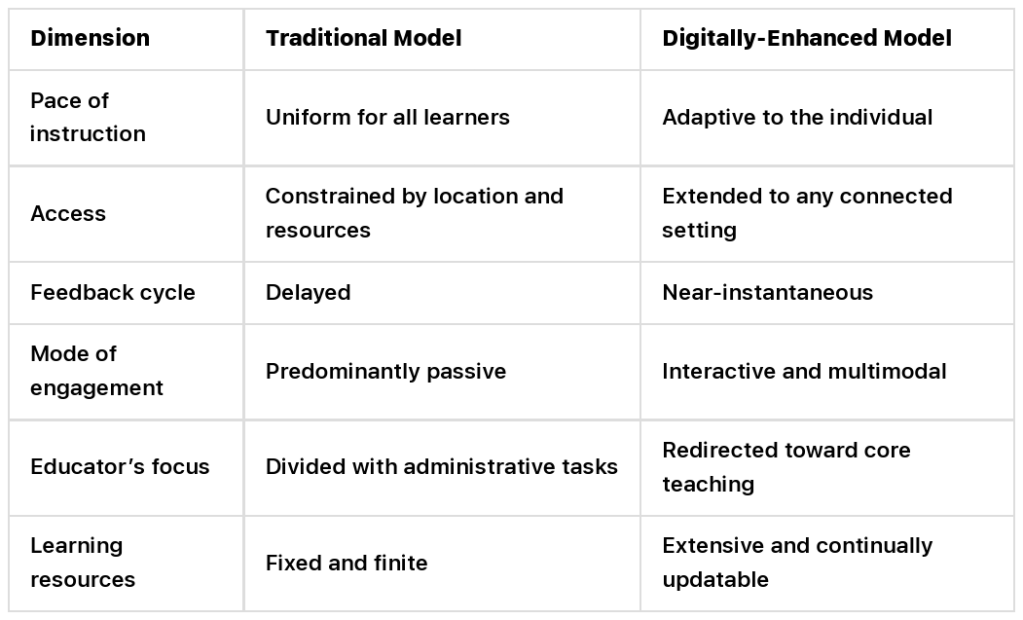
Conventional instruction is necessarily calibrated to the average learner, disadvantaging those who require additional support as well as those capable of accelerated progress. Adaptive digital tools mitigate this constraint by permitting each student to proceed at an appropriate pace — reviewing material as needed or advancing without artificial restraint. This aligns with well-established principles of differentiated instruction.
Expansion of Access and Equity
Digital delivery reduces the historical dependence of educational quality upon geography and institutional resources. Learners previously without access to libraries, laboratories, or subject specialists may now reach all three through connectivity alone. For under-served populations, digital access frequently represents a first, rather than a supplementary, point of entry to quality instruction.
Enhanced Engagement
Interactivity supports deeper cognitive processing than passive reception of information. Simulations, gamified exercises, and multimedia representations allow abstract concepts to be encountered through multiple modalities, supporting retention and comprehension in a manner difficult to achieve through static text alone.
Instructional Efficiency
Automated assessment, reporting, and analytics reduce the administrative burden on educators. The consequent redistribution of time toward mentorship, individualised feedback, and higher-order instruction — functions that remain irreducibly human — arguably constitutes one of the most valuable contributions of digital tools.
Development of Future-Relevant Competencies
The environments into which learners graduate are increasingly digital. Learning conducted through technology cultivates the digital fluency, adaptability, and collaborative skills that contemporary professional contexts demand.
Comparative Overview
Conditions and Caveats
Intellectual honesty requires acknowledgement that the benefits described are contingent, not automatic. Digital products deployed without pedagogical purpose may distract rather than instruct; excessive reliance on passive consumption may displace active reasoning; and no technology substitutes for the relational and motivational role of a skilled educator.
These observations, however, constitute an argument for principled implementation rather than exclusion. The determinative variable is not the presence of technology but the quality of its integration. Where digital products complement — rather than replace — sound teaching, the evidence of benefit is compelling.
Conclusion
Digital products have not displaced the instructor, the classroom, or the text; they haveaugmented each, extending their reach, enriching their possibilities, and improving equity of access. When implemented with clear intent and appropriate safeguards, such tools are, on balance, a genuine boon to education. They do not represent a distant future awaiting arrival, but a present reality already contributing meaningfully to teaching and learning.
Frequently Asked Questions (FAQs)
Q1. Do digital products replace the role of the teacher?
No. Digital tools automate routine tasks and expand instructional resources, but the relational, motivational, and judgement-based functions of teaching remain irreplaceably human. The most effective models position technology as a complement to, not a substitute for, the educator.
Q2. Are digital learning tools suitable for all age groups?
Suitability depends on developmental stage and design. Younger learners generally benefit from structured, supervised, and time-limited use, whereas older students can engage with more independent and complex digital environments. Age-appropriate design and moderation are essential.
Q3. Does increased screen time associated with digital learning pose a concern?
It can, if unmanaged. The concern is best addressed not by avoidance but by balance — combining screen-based activities with offline reflection, discussion, and practice, and ensuring that screen use is purposeful rather than passive.
Q4. Can digital products genuinely improve equity, given the digital divide?
Digital tools possess strong equalising potential, but only where connectivity and devices are accessible. Realising the equity benefit therefore depends on parallel investment in infrastructure and access; the tools themselves are necessary but not sufficient.
Q5. How can educators ensure digital products enhance rather than hinder learning?
By selecting tools with a clear pedagogical rationale, integrating them into well-designed lessons, maintaining active teacher involvement, and evaluating outcomes rather than adopting technology for its own sake.
Q6. Is there evidence that digital learning improves outcomes?
Research broadly indicates that well-designed and well-implemented digital tools can improve engagement, retention, and access. Outcomes are strongly mediated by implementation quality, however — the same tool may succeed or fail depending on how it is used.The author welcomes scholarly and practitioner responses. Readers are invited to share their institutional experiences of digital integration in the discussion below.


Leave a comment