Walk into most classrooms and you’ll find the same story on the shelves: laminated flashcards, plastic counting cubes, glossy charts bought in bulk. They work. But somewhere between the purchase order and the child’s hands, something gets lost — the sense that learning materials are made, that they come from somewhere, and that a bottle cap can be just as good a teacher as a factory-printed manipulative. Turning waste into handmade teaching materials flips that logic. A cereal box becomes a shape-sorting board. Bottle caps become counters, alphabet tiles, or a colour-matching game. Newspaper becomes papier-mâché models of the solar system. And in the making, the lesson starts long before the material is ever used. Here’s what actually changes when classrooms take this seriously.
Children learn that resources are created, not just consumed
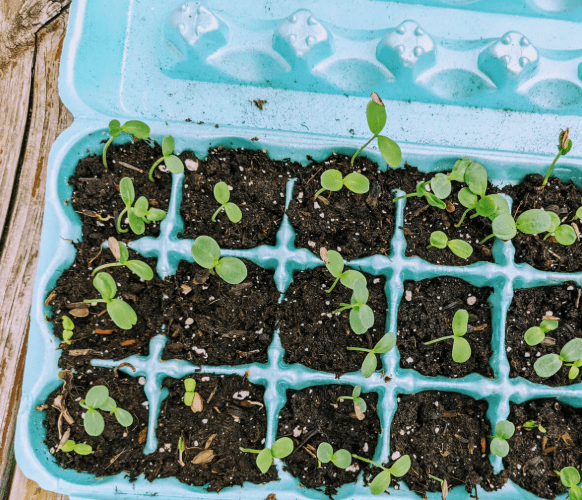
There’s a quiet but powerful shift when a child watches a teaching aid come together from what was headed for the bin. Store-bought materials arrive finished; their origins are invisible. A handmade counting board made from egg cartons carries its whole history — the child saw the carton before, during, and after. This does more than teach a topic. It teaches that value can be added, that “useless” is often just a lack of imagination, and that the child’s own hands can transform things. For primary-school children — old enough to grasp the idea, young enough to be shaped by it — that sense of agency is foundational. It’s the difference between receiving knowledge and participating in its creation.
The making is the curriculum
The most underrated benefit is that building the material teaches as much as using it. When children measure, cut, sort, and assemble, they’re practising fine motor skills, spatial reasoning, sequencing, and planning — often without realising they’re “doing school.”Sorting waste by type is early classification and set theory. Measuring cardboard for a model is applied maths. Deciding how to reuse an odd-shaped container is genuine problem-solving. Working in a group to build something is collaboration and negotiation. A bought manipulative arrives with all these decisions already made. A handmade one leaves them for the child.
It makes quality learning affordable and scalable
Not every school can spend on branded educational kits, and most primary schools — especially in under-resourced districts — run on tight budgets with large class sizes. Waste-based materials collapse the cost barrier almost entirely. A full set of number cards, sorting trays, fraction strips, and story props can be built from what a household throws out in a week, and multiplied across a whole class for next to nothing. This matters beyond economics. When materials are cheap and replaceable, teachers use them more freely. Children handle them without the anxiety of “don’t break the expensive thing.” And when something wears out, you simply make another — the supply is endless because the raw material is, unfortunately, endless too.
Environmental values become lived, not lectured
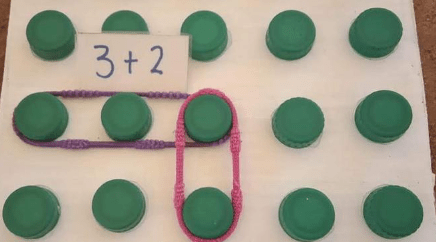
Most environmental education happens through posters and slogans: reduce, reuse, recycle. Children can recite the words long before they believe them. Building a maths game out of plastic caps does something the poster can’t — it makes the principle physical. The child doesn’t just hear that waste can be reused. They hold the proof. They spent a Tuesday afternoon turning rubbish into something they now play with every day. That’s a memory, not a message, and memories are what change behaviour. A generation that grows up making things from waste carries a different instinct about what “throwing away” even means.
It personalises learning in ways mass production can’t
Off-the-shelf materials are designed for the average child who doesn’t exist. Handmade ones bend to the actual children in the room. A teacher can make counters in the exact colours a struggling learner responds to, build vocabulary cards around the local language and objects children recognise, or scale a game up and down for differentability levels — all for free, all overnight. This is where the approach quietly outperforms expensive kits. Relevance beats production value. A rough cardboard clock labelled with a child’s daily routine teaches time better than a perfect plastic one that means nothing to them.
A word on doing it well
The impact is real, but it isn’t automatic. Waste-based materials work best when they’re purposeful rather than decorative — tied to a clear learning goal, safe (no sharp edges, clean containers, non-toxic materials), and durable enough to survive real classroom handling. The goal is a genuine teaching tool, not a craft that looks good on a display board and falls apart by Friday. Done thoughtfully, though, the outcome is hard to beat: cheaper classrooms, more capable children, greener habits, and learning that carries the fingerprints of the people who made it.
Frequently asked questions
What kinds of waste actually make good teaching materials?
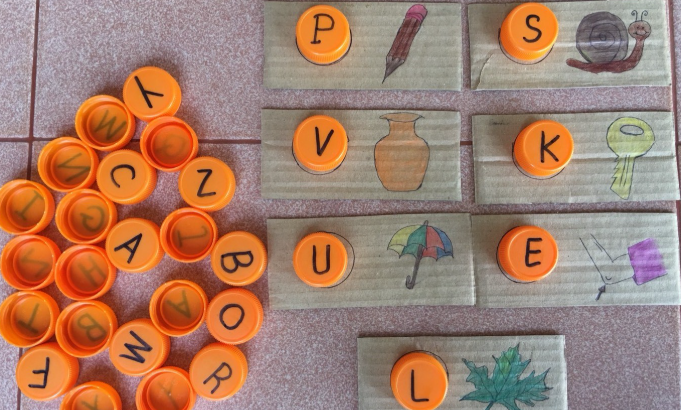
The most versatile are cardboard boxes and tubes, plastic bottles and caps, egg cartons, newspaper, fabric scraps, jar lids, and clean food containers. Bottle caps alone can become counters, alphabet tiles, colour-matching games, and sorting sets. The rule of thumb: if it has a consistent shape, a surface you can write on, or parts that come apart, it can probably teach something.
Are waste-based materials safe and hygienic for children?
They can be, with basic care. Wash and dry food containers thoroughly, avoid anything sharp or with jagged edges, skip materials that once held chemicals or medicines, and use non-toxic glue and paint. For very young children, avoid small parts that pose a choking risk. Safety is a preparation step, not a reason to avoid the approach.
Do handmade materials really teach as well as store-bought ones?
Classroom research suggests they often teach more, not less — because open-ended, self-made materials encourage divergent thinking, problem-solving, and fine motor development that finished products skip. The child participates in creating the tool, which deepens engagement. Store-bought kits win on polish; handmade ones win on relevance and involvement.
Won’t they fall apart quickly?
Some will, and that’s partly the point — they’re free to replace. But durability improves a lot with simple reinforcement: laminating cardboard cards, covering surfaces with clear tape, or coating with a layer of glue. Aim for toolssturdy enough to survive real classroom handling rather than fragile crafts meant for a display board.
Which age groups benefit most?
Early childhood and primary learners benefit most visibly, since so much learning at that stage is hands-on and sensory. But the principle scales up — older students can build models, science apparatus, and geometry aids from waste, adding design and engineering thinking to the mix.
How do I get started without spending money?
Begin by collecting a week’s worth of clean household waste, then pick one clear learning goal — counting, letter recognition, sorting, storytelling — and build a single material for it. Ask parents to save and send in specific items. Starting small and purposeful beats making a large pile of crafts with no teaching aim.
Does this really help the environment, or is it symbolic?
Both. The direct waste diverted by one classroom is modest. The lasting impact is behavioural: children who spend afternoons turning rubbish into useful things grow up with a different instinct about what “throwing away” means. The environmental lesson is lived rather than lectured, which is what makes it stick.
The bigger picture
We often treat “waste” and “teaching material” as opposite ends of value — one worthless, one costly. The most interesting thing about bridging them is what it reveals: that the gap was never as wide as we assumed. A child who learns their numbers on bottle caps learns something extra, something no printed set can teach — that the world is full of raw material waiting for someone with an idea.
That might be the most important lesson of all.


Leave a Reply